

Funding for Home Care

Funding for Home Care


If you or a loved one needs help with home care costs, the first step is to contact your local council's Adult Social Care department. They will arrange a care needs assessment  to evaluate what support is required and explain the funding options available.


You can usually start this process by:

  • Visiting your local council’s website and searching for “adult social care” or “care needs assessment.”
  • Calling the council’s social services or care and support team.
  • Asking your GP, hospital social worker, or community nurse for advice and referrals.


If the assessment concludes that you have eligible care needs, a financial assessment (means test) will determine whether you qualify for local authority funding.


You can also contact national organisations like Age UK, Carers UK, or Independent Age  for free advice on funding and benefits.


Types of Funding for Home Care in the UK


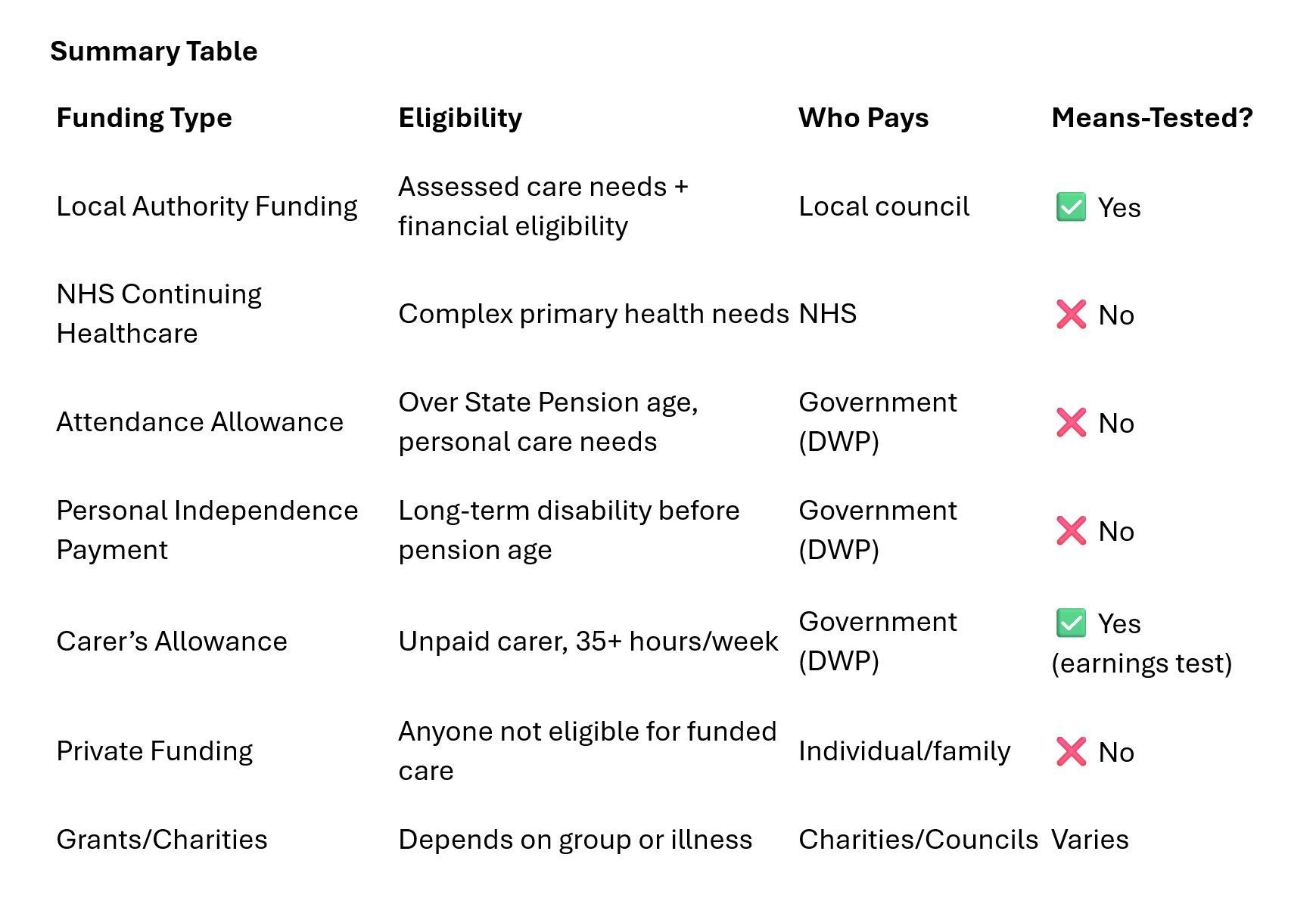
1. Local Authority Funding (Social Care Funding)

Local councils provide funding for home care based on a care needs assessment  and a means test.


  • Needs Assessment: Evaluates your care needs and whether they meet the eligibility criteria under the Care Act 2014.
  • Financial Assessment: Reviews income, savings, and assets. The thresholds in England (2025) are:
  • Over £23,250: You are expected to self-fund your care.
  • Between £14,250 and £23,250: You will contribute part of the cost.
  • Under £14,250: Only income is considered; savings are ignored.

⚠️ Note: These thresholds apply in England. Scotland, Wales, and Northern Ireland have different systems and limits.

  • If you qualify, the council may arrange care for you or provide direct payments so you can choose your own care provider.


🔗 More info:
Gov.uk - Care and support
Age UK - Paying for care at home


2. NHS Continuing Healthcare (CHC) Funding

NHS Continuing Healthcare is a package of care arranged and fully funded by the NHS for individuals with primary health needs.


  • CHC can cover care in your own home, including nursing, personal care, and specialist equipment.
  • Eligibility is based on a Decision Support Tool (DST) used by an Integrated Care Board (ICB), which replaced CCGs.


✅ Key points:

  • Not means-tested.
  • Based entirely on your health needs, not your finances.
  • Often assessed when someone leaves hospital or experiences significant health deterioration.


🔗 NHS - Continuing Healthcare


3. Attendance Allowance (AA)

Attendance Allowance is a non-means-tested benefit for people over State Pension age who need help due to a disability or illness.


  • Lower rate (£72.65/week): For help during the day or night.
  • Higher rate (£108.55/week): For help during both or if terminally ill.


⚠️ 2025 rates updated.

You can use AA to help pay for care, but it does not directly fund services.

🔗 Gov.uk - Attendance Allowance


4. Personal Independence Payment (PIP)

PIP is for people aged 16 to State Pension age with long-term health conditions or disabilities.

It includes two components:


  • Daily Living: For tasks like preparing food, washing, and managing treatment.
  • Mobility: For moving around or planning a journey.


Each is paid at either a standard or enhanced rate based on the level of need.

PIP is not means-tested, and you can use it toward care costs.

🔗 Gov.uk - Personal Independence Payment


5. Carer’s Allowance and Related Benefits

If you provide regular, unpaid care, you might qualify for:


  • Carer’s Allowance (£81.90/week in 2025): For caring 35+ hours/week for someone on a qualifying disability benefit.
  • Other support: Carer’s Credit (for pension), council tax discounts, or access to support groups.

⚠️ You must earn less than £151/week (2025 limit) after deductions to qualify.

🔗
  Gov.uk - Carer’s Allowance
 
Turn2Us - Benefits calculator


6. Self-Funding (Private Funding)

If you have savings above the threshold or are ineligible for NHS or council help:


  • You will need to arrange and pay for care yourself.
  • You can still request a care needs assessment for advice and guidance.
  • Some people use equity release, pensions, or income to pay for care.

🔗
  Age UK - Paying for care
  CQC - Choosing a care provider


7. Other Support and Grants

Charities, foundations, and local councils may offer:


  • Condition-specific grants (e.g. Parkinson’s UK, MS Society)
  • Local welfare assistance schemes
  • Hardship funds, equipment loans, or respite breaks

Always check local authority websites and national charity pages.


🔗 Examples:
Contact us:

📞 Call us on 01483 721515 
📧 Email:
info@districthomecare.co.uk

📄Enquiry form

12 September 2025
Organising Care
12 September 2025
Choosing a Care Agency
12 September 2025
🍃 Environmental Sustainability
12 September 2025
🌍 Caring for People and the Planet
12 September 2025
Supporting Our Team’s Mental Health with Bupa’s Employee Assistance Programme
12 September 2025
We are committed to delivering exceptional, person-centred care by building a team of compassionate, dedicated, and skilled individuals. While we actively recruit experienced professionals, we are equally enthusiastic about speaking to those who are new to the care sector but have the right values and a genuine desire to make a difference. No previous care experience, we provide full training and support to help our staff gain skills and confidence. All members of our care team, regardless of experience, complete a thorough recruitment and training process, which includes: · Face to Face interviews and detailed reference checks · A structured induction and orientation programme · Practical skills assessments and experience verification · To ensure the highest standards of safety and quality for those we support, we also implement the following quality assurance measures · Enhanced Disclosure and Barring Service (DBS) checks · Verified Care Certificate or equivalent health and social care qualifications (training provided if not held) · Full public liability and professional indemnity insurance · Employers’ liability and workers’ compensation cover · Ongoing mandatory training and Continuing Professional Development (CPD) Thoughtfully arranged introductions between clients and care staff to foster trust, familiarity, and continuity We are proud to support career development at every stage, offering fully funded qualifications in Adult Health and Social Care—from Entry Level through to Level 5. Whether you're just starting out or looking to advance your career, we provide structured pathways to help you succeed and grow. This approach ensures every member of our team is confident, capable, and supported to deliver high-quality, compassionate care in the home. Interested in joining our team or want to learn more? Contact Us for Further Information:
12 September 2025
If caring for others comes naturally to you, why not put your compassion to good use and support someone who truly needs it? Your kindness could make a real difference in their life and help them feel more positive about their own circumstances. At District Home Care, we believe in making a real difference — not just to the people we support, but to the incredible people who work with us. Whether you’re new to care or an experienced professional, we welcome you to join a team that values compassion, commitment, and community. Why Choose District Home Care? Competitive Pay We offer good rates of pay that reflect the vital role our carers play. Your work deserves to be rewarded fairly. Recognition That Matters From “Carer of the Month” shoutouts to long-service awards, your efforts never go unnoticed. We celebrate the people who make our service outstanding. Clear Pathways for Progression Whether you want to specialise, take on more responsibility, or move into leadership — we’re here to help you grow. With access to ongoing training, qualifications, and development opportunities, your career in care can go as far as you want it to. Guaranteed Hours & Job Security We offer guaranteed contracted hours, providing the stability you need, with flexible working patterns that support your lifestyle. Supportive Team Culture You’ll never feel like just a number. We’re a close-knit, professional team that looks out for each other. No Experience? No Problem. If you’re kind, reliable, and want to make a difference, we’ll give you full training and mentoring to get started with confidence.
11 September 2025
We offer a wide range of services to help you live well and safely at home from as little as 30 minutes per day to all day and night care.
11 September 2025
We offer a wide range of services to help you live well and safely at home from as little as 30 minutes per day to all day and night care.
11 September 2025
We understand that everyone’s situation is different. That’s why our care services are designed to support: Individuals living alone, helping to promote independence, reduce loneliness, and ensure daily needs are met. Couples living together, even if one or both have different levels of care needs. We support both partners in remaining together at home, preserving relationships and routines. Our approach is person-centred, meaning we take time to understand your lifestyle, routines, preferences, and health requirements before creating a personalised care plan.